Microsoft AI Chips: Maia 300 vs. Maia 200
Microsoft's Maia 300 chips are expected to be deployed in 2027. But what does it mean for an average consumer, if anything at all?
In this article
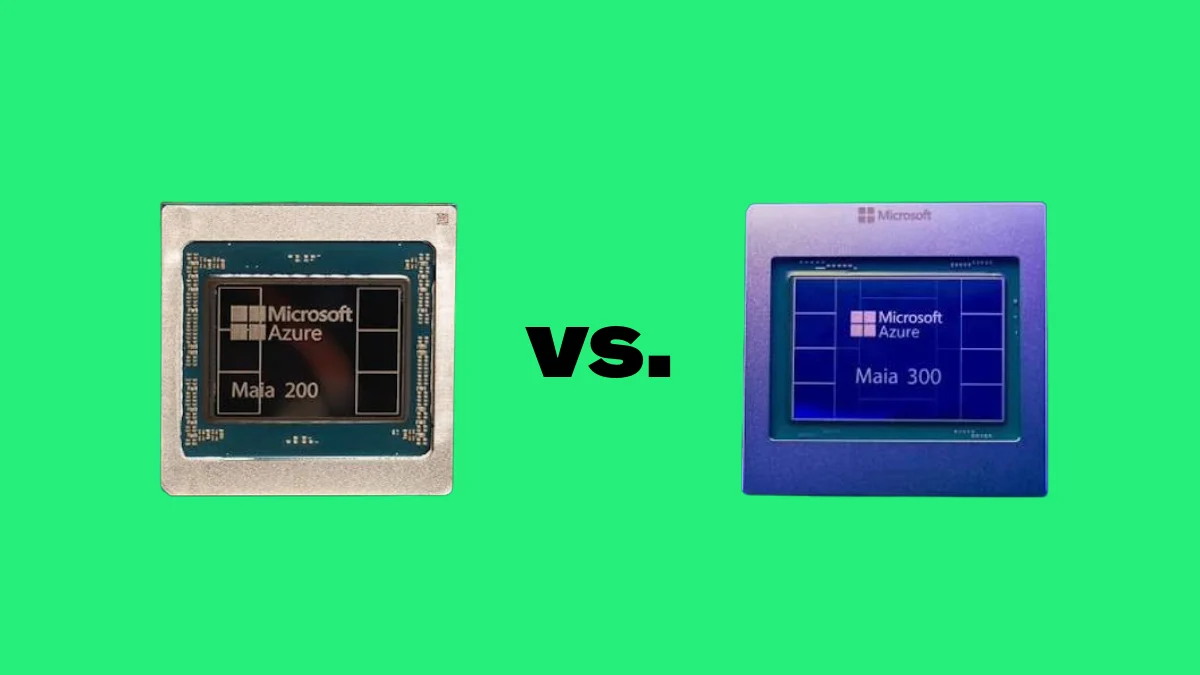
Microsoft just unveiled the Maia 300, the third generation of its in-house AI chip, and it's a big jump over the Maia 200 that launched in January. But here's the short answer most laptop shoppers are looking for: no Maia chip will ever sit inside your laptop. Maia lives in Microsoft's data centers. Its real effects on the laptop world are indirect, and one of them (memory supply) is already hitting what you pay for a new PC.
Key takeaways
- Maia 300 moves to 288GB of next-gen HBM4 memory with 18 TB/s of bandwidth, up from 216GB and 7 TB/s on Maia 200.
- Microsoft claims a 96-chip Maia 300 rack delivers up to 7x the token throughput of a Maia 200 rack. Production deployments start in 2027.
- Maia is a data center inference chip. It isn't sold to consumers and won't appear in Surface or any other laptop.
- For laptop buyers, the bigger story is memory: AI data centers are soaking up memory supply, and analysts expect higher PC prices and longer upgrade cycles as a result.
What are Microsoft's Maia AI Chips?
Maia is Microsoft's family of custom AI accelerators, built to run AI models inside Azure instead of relying entirely on GPUs from Nvidia and AMD. The first chip, Maia 100, was built on TSMC's 5nm process, according to HPCwire. The Maia 200 followed in January 2026, and Microsoft revealed the Maia 300 on October 12, 2026, at the OCP Global Summit in San Jose, as Yahoo Finance reported.
Two things are worth knowing up front. First, Maia chips focus on inference: running AI models that are already trained, which is what happens every time you ask Copilot a question. Second, Maia is not Microsoft's only chip line. Redmond Magazine points out that Cobalt is a separate Arm-based server CPU, so don't mix the two up.
Today, Maia 200 already handles production work such as Microsoft 365 Copilot, OpenAI models, and Microsoft's own MAI models. With Maia 300, Microsoft says its Maia chips will become the "primary AI inference system for Microsoft products and services."
Maia 300 vs. Maia 200: Specs Side-by-Side
Microsoft hasn't published every Maia 300 figure yet, so the table below sticks to numbers that Microsoft has stated and U.S. outlets have reported. Where a number isn't public, we say so instead of guessing.
| Spec | Maia 200 | Maia 300 |
|---|---|---|
| Announced | January 26, 2026 | October 12, 2026 |
| Manufacturing | TSMC 3nm, 140B+ transistors | Multi-chiplet; compute on TSMC N2P (2nm class) |
| Memory | 216GB HBM3e | 288GB HBM4 (8 stacks) |
| Memory bandwidth | 7 TB/s | 18 TB/s |
| Peak compute | 10+ PFLOPS FP4, 5+ PFLOPS FP8 | Not yet published; supports enhanced MXFP4 |
| Chip power (TDP) | 750W | Not yet published |
| System building block | 4 chips per tray; clusters up to 6,144 chips | 96 chips per rack; up to 7x Maia 200 rack throughput |
| Efficiency claim | 30% better performance per dollar vs. Microsoft's existing fleet | 40% more tokens per megawatt vs. unnamed "leading GPU-based systems" |
| Status | Live in Microsoft's Iowa region at launch, Arizona next | Production deployments begin in 2027 |
The memory leap at a glance
Memory capacity: Maia 200 · 216GB
Memory capacity: Maia 300 · 288GB (+33%)
Memory bandwidth: Maia 200 · 7 TB/s
Memory bandwidth: Maia 300 · 18 TB/s (about 2.5x)
Maia 200 figures come from Microsoft's launch post. Maia 300 figures come from Microsoft's October 12 announcement as reported by Quartz, Interesting Engineering, and UPI. UPI also quotes Microsoft saying Maia 300 brings about 2x the HBM bandwidth per watt of Maia 200.
Why Memory is the Headline Upgrade
When an AI model writes a response, it produces it one token (a chunk of a word) at a time, and the chip has to pull the model's weights out of memory over and over to do it. That makes memory bandwidth a hard ceiling on how fast answers come back. So the jump from 7 TB/s to 18 TB/s matters more for a chatbot's speed than raw compute does. The extra capacity also lets larger models and longer conversations fit closer to the processor. According to Interesting Engineering, Microsoft plans to use Maia 300 for cloud inference, its own model development, and agent-based coding tools.
The Fine Print
Treat the efficiency numbers as Microsoft's claims, not settled results. Microsoft didn't say which GPU systems it measured the 40% tokens-per-megawatt figure against, and UPI notes that no third party had tested Maia 300 as of launch day. The chip also isn't something anyone outside Microsoft can rent yet. Unlike Google's TPUs or Amazon's Trainium, Quartz reports that Maia hasn't been offered to outside customers as a cloud resource. And Nvidia isn't going anywhere: Microsoft still uses Nvidia and AMD hardware for training.
Does Maia 300 Change Anything for Laptops?
Not directly, but it touches laptops in three ways worth understanding before your next purchase.
1. Your Laptop's AI Hardware is a Different Story
The AI silicon inside a laptop is an NPU, an integrated GPU, or a discrete GPU, not a Maia chip. Copilot+ PCs use their NPUs for on-device features, while heavier Copilot requests go out to Microsoft's cloud. Microsoft's own laptop roadmap actually leans on a partner here: the new Surface Laptop Ultra uses Nvidia's N1X chip, pairing a Blackwell RTX GPU with up to 128GB of unified memory. We covered that platform in our deep dive on Nvidia RTX Spark laptops. So Maia 300 doesn't make any current laptop obsolete, and it doesn't raise the hardware bar for running Windows or Copilot locally.
2. Cloud Copilot on Your Laptop Should Get Cheaper to Run
Every time your laptop sends a prompt to Copilot, Microsoft 365 Copilot, or GitHub Copilot, a data center does the work. Microsoft says Maia will become the main engine for that work starting in 2027, and GitHub Copilot and Microsoft Foundry are expected to adopt Maia hardware by the end of 2026. If Microsoft's efficiency claims hold up, cheaper inference gives it room to offer more cloud AI features without asking you to buy a more powerful machine. That's our read, not a Microsoft promise. Still, it's one reason we think most people don't need to chase top-tier local AI hardware; our take on that debate is in Should I buy a Copilot+ PC?
3. The Memory Squeeze is the Effect You'll Actually Feel
This is the real link between AI chips and the laptop on your desk. Each Maia 300 carries 288GB of HBM4, and Microsoft has reportedly negotiated for more than 300,000 units in 2027, with an eventual goal above one million. Maia is one buyer among many: Nvidia, AMD, Google, Amazon, and others are all chasing the same high-bandwidth memory. Memory makers have been shifting production toward that higher-margin data center memory, which leaves less capacity for the regular DRAM and SSDs that go into laptops.
The analyst forecasts show how much that matters. Gartner projects that combined DRAM and SSD prices will climb about 130% by the end of 2026, lifting average PC prices by 17% compared with 2025. Gartner also expects memory to rise from 16% to 23% of a PC's bill of materials, and it predicts the sub-$500 entry-level PC segment will disappear by 2028. IDC, as reported by PCWorld, cut its 2026 forecast to an 11.3% drop in PC unit sales and expects memory shortages to last well into 2027. We broke down the knock-on effects in The 2026 Memory Crunch.
There's also competition for factory time. Redmond Magazine notes that Microsoft has to fight for TSMC's most advanced wafers, advanced packaging, and HBM against Nvidia, AMD, and other AI chip developers. Nobody can say exactly how much any single chip program moves laptop prices, but the direction is clear: as long as AI data centers keep expanding, laptops compete with them for parts.
What This Means if You're Shopping for a Laptop
- Don't wait for "Maia laptops." They aren't coming. Buy based on the CPU, GPU, NPU, and memory you actually need.
- Prioritize RAM at purchase time. Memory is the most price-sensitive part of a new laptop right now, and most thin laptops can't be upgraded later.
- Remember most AI happens in the cloud. If your AI use is mainly Copilot, ChatGPT, or similar chat tools, a fast connection matters more than a huge NPU.
- Expect to keep devices longer. Gartner expects consumers to hold onto PCs about 20% longer by the end of 2026, which keeps demand for quality used laptops high.
Resale Value: Why AI Data Centers Could Be Good News for Your Old Laptop
Here's the upside of the memory crunch. When new laptops cost more and entry-level models thin out, more buyers turn to used and refurbished options, and well-kept laptops with generous RAM and storage hold their appeal. If you're upgrading, or a newer computer has replaced one that's now sitting in a drawer, Gadget Salvation makes selling it simple. Quotes are calculated based on resale market data, offers are locked for 30 days, shipping is prepaid, and every drive gets a BitRaser data wipe. Selling a Surface? Start with our Microsoft Surface buyback page, and check our guide on how to sell a used Microsoft laptop first. Passing a working laptop to its next owner also keeps it out of the e-waste stream, which matters more as AI's own energy and resource footprint keeps growing.
The Bottom Line
Maia 300 is a serious upgrade over Maia 200, driven mostly by a big step up in memory capacity and bandwidth, and it signals that Microsoft wants its own silicon running most of its AI services by 2027. It won't change what goes inside your next laptop. What it does reflect is the AI build-out that's pulling memory away from consumer devices, and that's the trend to factor into when you buy, how much RAM you choose, and when you sell your current machine.
Sources:
- Microsoft — Maia 200: The AI accelerator built for inference — Maia 200 process node, transistor count, FP4/FP8 compute, HBM3e capacity and bandwidth, SRAM, 750W TDP, tray and cluster design, performance-per-dollar claim, deployment regions
- Microsoft — Microsoft to expand Azure Maia system to multi-gigawatt deployments — Maia 300 announcement and 2027 deployment plan
- Yahoo Finance — Microsoft reveals Maia 300 AI chip as it works to reduce dependence on Nvidia, AMD — OCP Global Summit reveal, tokens-per-megawatt claim, 96-chip rack and 7x throughput claim, current Maia 200 workloads
- Quartz — Microsoft Maia 300 AI chip to lead inference workloads — N2P chiplets, 288GB HBM4, 18 TB/s, reported TSMC volume talks, no outside rental, continued Nvidia and AMD use for training
- Interesting Engineering — Microsoft Maia 300 96-chip rack hits 40% more tokens per megawatt — eight HBM4 stacks, MXFP4 support, GitHub Copilot and Foundry adoption timing, intended workloads
- UPI — Microsoft announces new AI chip Azure Maia 300 — memory bandwidth, capacity, and HBM bandwidth-per-watt comparisons with Maia 200; no third-party testing at launch
- HPCwire — Microsoft Raises the AI Inference Bar with Maia 200 — Maia 100 process node
- Redmond Magazine — Microsoft Presses Forward Maia Custom AI Silicon — Cobalt vs. Maia distinction, competition for TSMC capacity, packaging, and HBM
- PCWorld — Microsoft is making it crystal clear there will be no Windows 12 — Surface Laptop Ultra with Nvidia N1X, Blackwell RTX GPU, and up to 128GB unified memory
- Gartner — Gartner Says Surging Memory Costs Will Reduce Global PC and Smartphone Shipments in 2026 — DRAM and SSD price surge, PC price increase, memory share of PC bill of materials, longer PC lifetimes, sub-$500 segment outlook
- PCWorld — The era of bargain-priced PCs is behind us — IDC's revised 2026 PC shipment forecast and memory shortage timeline
Last reviewed October 12, 2026. Maia 300 specifications are early vendor claims, and memory and PC pricing forecasts change frequently.