HP Pavilion Laptops: The Most Common Laptop We Buy
No laptop family comes through our inspection bench more often than the Pavilion. That ubiquity is exactly why its quote is decided by the spec sheet and the hinges.
In this article
If you want to sell your laptop and it happens to be an HP Pavilion, you are in the largest crowd there is. HP is the world's second-biggest PC maker — about 19.3% of shipments in Gartner's Q1 2026 figures — and for most of three decades the Pavilion was the machine it sold to ordinary people. HP retired the name in May 2024, folding its consumer laptops into the OmniBook family, but the installed base is vast and we will be quoting Pavilions for years. Here is the thing that surprises people: with a laptop this common, the badge earns you nothing. The specification and the condition are the entire quote.
Thirty years of being the default HP
The Pavilion began in 1995, not as a laptop but as a consumer desktop — HP's attempt to sell computers to households rather than to engineering departments. Its decisive moment came in 2002, when HP absorbed Compaq and inherited the Presario range along with the distribution muscle to put a cheap HP in every big-box store in the country. The Pavilion became the default answer to "I need a laptop," and stayed that way.
That history is why the line is so hard to generalise about. A family that spans thirty years, every price point from $350 to $1,200, and both desktops and notebooks does not have a characteristic resale value. It has a range, and your machine's place in that range is set by four things: the model, the storage, the specifications and the condition.
The dv years, and why ubiquity cuts both ways
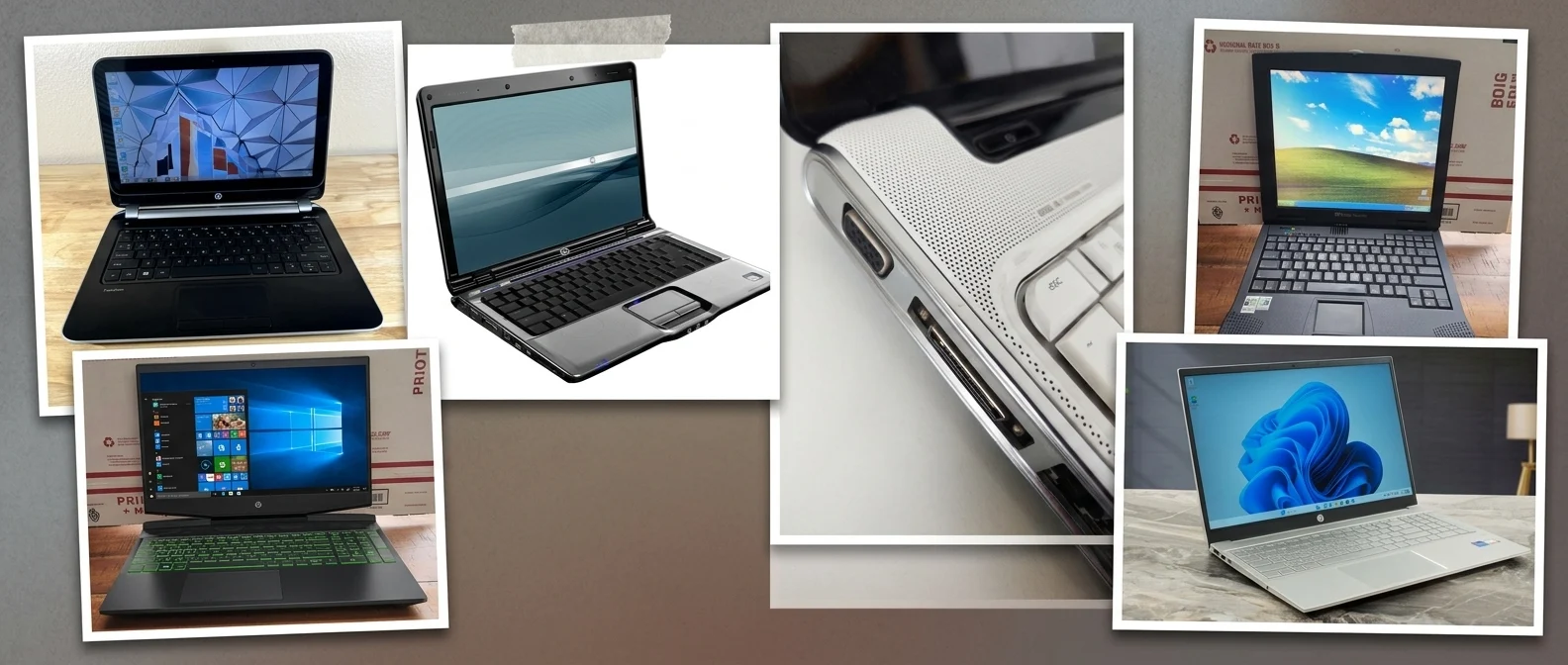
Anyone who used a laptop in the late 2000s remembers the dv series — the dv6 and dv7 were everywhere, in glossy piano-black plastic, and they are still the machines most often dug out of a closet and offered to us. They are also a clean illustration of why "common" is not the same as "valuable."
Scarcity is part of what makes any used item worth money, and the Pavilion has never been scarce. When a model shipped in the millions, there is no premium for finding one; the market price is set by supply, and supply is enormous. What that leaves is the only thing that still varies between two otherwise identical machines — what is inside it and what shape it is in. A laptop buyer working from live resale comps will price a 2011 dv6 at recycling value and a current Pavilion Plus with 16GB and an SSD at real money, and the reason is not brand sentiment.
Which Pavilion do you have?
Check the sticker or run dxdiag before looking up a price. The sub-line matters more
than the year.
| Variant | What it is | Typical resale picture |
|---|---|---|
| Pavilion (standard 14/15) | The mainstream volume model | Modest; CPU generation and RAM decide it |
| Pavilion x360 | Convertible touchscreen | Hinge and digitiser condition dominate |
| Pavilion Aero 13 | The light one, about 1kg from 2021 | Strong for its tier; genuinely sought after |
| Pavilion Plus | Later variants specified above the standard line | Among the best of the family |
| Pavilion Gaming | Entry gaming with a discrete GPU | Priced on the GPU, not the chassis |
The Aero is the one people undervalue. HP launched it in 2021 at around a kilogram — its lightest consumer laptop, and under $800 new — and light machines in good order hold their value better than the Pavilion name suggests. If you have an Aero, get an actual quote before assuming it is worth the same as a plastic 15-inch.
HP's gaming machines sit outside this family altogether. Omen and Victus are priced on the graphics card above all else, so if you want to sell gaming laptops from either range, start at the Omen page rather than here — the gap between a Victus and a standard Pavilion of the same year is not small.
2024: the Pavilion name became OmniBook
In May 2024 HP consolidated its consumer brands, retiring Pavilion along with Envy, Spectre and Dragonfly. By HP's own account the OmniBook 3 and 5 take the Pavilion's place, OmniBook X succeeds Envy and OmniBook Ultra succeeds Spectre — and the OmniBook name is a revival rather than an invention, having been on HP laptops back in the 1990s. Existing stock was not renamed, so Pavilions stayed on shelves well past the announcement.
For a seller this changes less than it sounds. Nothing about your laptop got worse because a marketing team reorganised, and resale is set by what the machine can still do. The one practical consequence is that a newer HP may carry either name, so check the sticker: an OmniBook and an Envy are quoted on their own pages, and a business ProBook on another again.
What the inspection bench actually checks
Because the specification is public and the condition is not, condition is where quotes move. Four things get looked at on every Pavilion, and all four are worth checking yourself before you describe the machine:
- The hinges and the lid. Plastic consumer chassis take the most abuse here, and a cracked hinge mount is both common and visible. On an x360 it matters twice over.
- Thermals. A machine that throttles or runs its fan constantly usually has years of dust in the heatsink. Worth noting honestly rather than hoping.
- The battery. Whether it holds a charge at all is a bigger factor than its cycle count.
- The screen. Pressure marks and dead pixels are easy to miss against a bright desktop background. Look at it on a plain white page and a plain black one.
Describe what you find. An accurate description is what keeps the first number and the final payment the same, and an optimistic one only produces a revised offer and a delay — you can accept that revision or have the laptop shipped back free, but neither is as good as being right the first time.
One warning specific to older HP consumer machines: a BIOS password you have forgotten is effectively terminal. It lives on the board, a clean Windows install will not touch it, and HP will not clear it from a serial number. A locked Pavilion is scrap regardless of how good the rest of it is.
Selling an HP Pavilion for cash, step by step
- Quote it. Find the model on the HP Pavilion page, answer the condition questions, and you have a real offer in under a minute. Free, no account, held for 30 days.
- Post it free. On accepting you get a prepaid UPS label by email. Box it with padding, add the charger, leave it at any UPS point. A properly packed parcel carries $100 of cover, and the label costs nothing until it is scanned.
- Get paid. Two to seven business days in transit, then inspection and payment inside two business days of arrival, by check, PayPal, Venmo, Zelle or Cash App.
No listing, no meeting in a car park, no payment that reverses three weeks later — which is most of the case for learning how to sell a laptop online through a buyback service instead of a marketplace. Drives are erased to NIST-compliant standards before anything is resold, and dead ones are destroyed rather than passed on; reset yours first anyway, as a matter of habit.
Frequently asked questions
Can I trade my laptop in if the screen is cracked?
Yes, at a reduced figure. A cracked panel is one of the most common faults we see on consumer laptops and it is priced in rather than refused. Say so in the condition questions and the quote accounts for it from the start.
Where can I sell my laptop if it is a Pavilion desktop or all-in-one?
Same place, different calculator. Pavilion covered towers and all-in-ones for most of its life, so if the real question is "where can I sell my computer", begin at sell your computer and choose the form factor there.
My Pavilion is from 2012. Is it worth anything?
Probably not as cash, and we will say so rather than let you post it. Machines of that age are usually recycling candidates — responsibly and at no cost to you — though a high-specification model of the era can still surprise. The time to trade in a laptop is while somebody still wants to use it, but a quote takes a minute and settles the question either way.
Does HP retiring the Pavilion name affect what you pay?
No. We quote on model and condition, not on whether a brand is still in production. The Pavilion back catalogue is among the deepest we price, and that will not change while people still have them.
Can I sell my PC and my laptop at the same time?
Yes, quote each one on its own calculator. Separate quotes keep each payout tied to the right machine, which matters if one of them turns out to be worth more than you expected.
Three decades of Pavilions have passed across this bench since we started in 2008, and more than 150,000 devices in total, at a 4.9-star Trustpilot rating. Quote your HP Pavilion now — free, no account, good for 30 days. If you are weighing it up against a retailer programme, our laptop trade-in guide compares the terms.