6 Reasons to Switch From a Samsung Galaxy to an iPhone
Galaxy phones are excellent. That is exactly why this decision deserves real numbers instead of brand loyalty — so here are six specific, documented reasons US owners make the jump, plus the honest cases where you should stay put.
In this article
Let us get one thing out of the way first: the Galaxy S26 is a phenomenal smartphone. Samsung makes gorgeous displays, its zoom cameras still embarrass most of the competition, and One UI has quietly become one of the most customizable interfaces on any phone. Nobody really switches from a Galaxy due to a subpar product complaint.
People do switch for other reasons. For example, they want to see some iOS features on Android. Or they already own a Mac or an Apple Watch, so tightening the Apple ecosystem by getting an iPhone is the next logical step.
We sourced online reports, Apple's documentation, and our own data to narrow down the main reasons users switch from Galaxy to iPhone.
The short version
Six reasons US Galaxy owners move to iPhone, in one screen:
- Update timing. iOS 27 reached every eligible iPhone on one day; One UI 9 is reaching Galaxy flagships in waves from September into October.
- Resale value. iPhone 17 models held roughly 87–89% of launch price after about ten months; Galaxy S26 models held 66–68% after about four.
- Ecosystem. An Apple Watch, a Mac handoff, or an AirDrop transfer all assume an iPhone is in your pocket.
- Privacy defaults. Cross-app tracking requires permission on iOS, and you can turn the prompt off entirely.
- Messaging. 87% of US teens own an iPhone, so in most American households the group chat is already there.
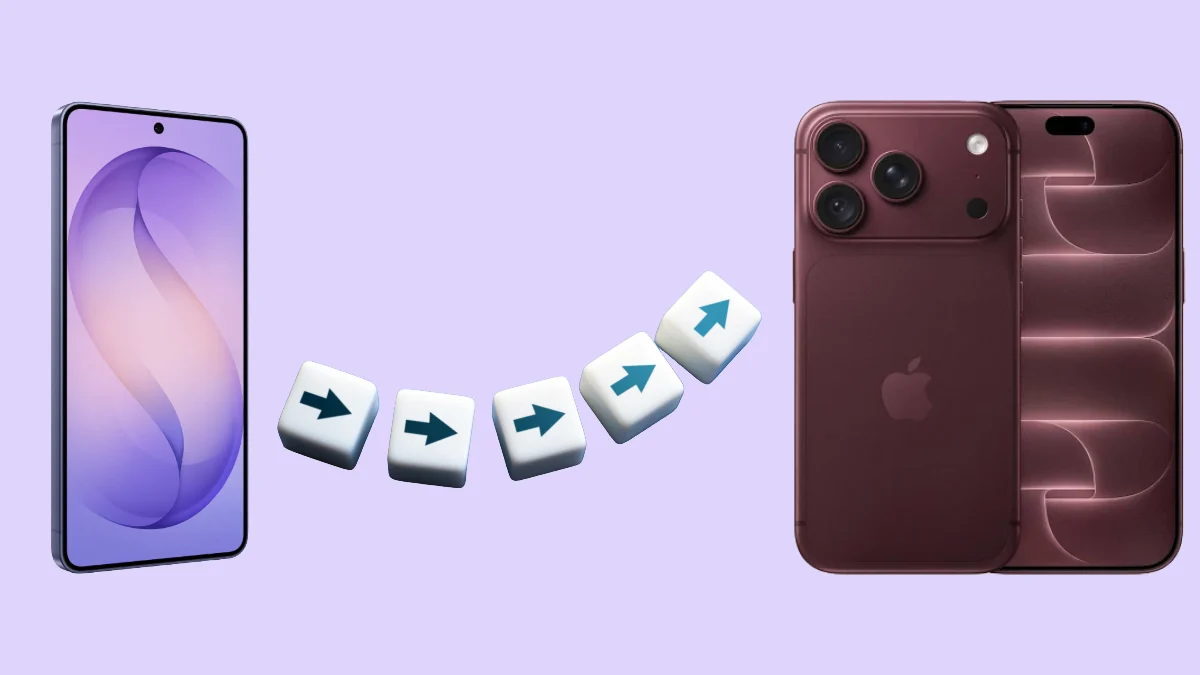
- An easy exit. You can go from Android to iOS and vice versa in one step, and your used Galaxy is worth real money today, but not so much next year.
Reason #1: Software Rollout Takes Too Long
This is the reason most Galaxy owners feel before they can articulate it. Apple released iOS 27 on September 14, 2026, and it arrived that day on every compatible iPhone going back to the 2019 iPhone 11 models. One tap, one afternoon, and everybody is up to date.
Samsung's equivalent release went out very differently. One UI 9, built on Android 17, went stable on July 22, 2026, but only for the Galaxy Z Fold 8 and Z Flip 8. The Galaxy S26 flagship line — a phone that went on sale in March 2026 — didn't start receiving it until September 16. Samsung's published roadmap puts the Galaxy S25 series and last year's foldables on September 28, with older flagships such as the Galaxy S23 FE waiting until October. If you bought a Galaxy S24 in 2024, you'll watch a version number arrive on other people's phones for roughly a quarter of the year before it reaches yours.
Credit where it is due: on length of support, Samsung has caught up and, in some respects, passed Apple. Since the Galaxy S24, Samsung has promised seven generations of Android upgrades and seven years of security patches on its flagships, which carries the Galaxy S26 into 2033. Apple publishes no fixed lifespan, but in practice iPhones see roughly five to seven years of major iOS upgrades and seven to eight years of security updates, with some models patched a decade after launch.
The honest read: Samsung wins the promise, Apple wins the delivery. If you care about how many years your phone is covered, it is a tie. If you care about being current the week a feature ships, iPhone is not close.
Reason #2: Your Galaxy Depreciates Too Fast
What this means for your Galaxy
Faster depreciation is an argument for selling sooner, not for holding on. The months between deciding to switch and actually listing the phone are the most expensive months of its life. At Gadget Salvation, we price every device against the most current resale market data and quote case by case, and your offer is locked before you ship — so a slow week in the market after you hit send is our problem, not yours.
Get a number for your Samsung Galaxy before you buy, so you are shopping with the real figure in hand. And when the iPhone you are about to buy eventually has its own turn, we buy those too.
Reason #3: The Rest of Your Gear is a Part of an Ecosystem
If there is no Apple hardware anywhere in your life, skip this one — it is worth nothing to you. But if there is a MacBook on your desk or an iPad on your couch, it may be worth more than the other five reasons combined.Apple groups these behaviors under Continuity, and they are the kind of thing you stop noticing within a week and then cannot live without. Handoff lets you start an email on the phone and finish it on the Mac by clicking one icon in the Dock. Universal Clipboard means text or an image copied on one device pastes on another with no intermediate step at all. AirDrop moves a 400 MB video between two devices in seconds with no app, no account, and no upload. Continuity Camera turns the phone in your pocket into the webcam for your laptop.
The Apple Watch remains the industry benchmark for consumer health hardware, featuring FDA-cleared ECG readings, advanced sleep architecture tracking, and irregular rhythm notifications that integrate seamlessly with the iPhone Health app. But it does not work with Android at all. Per Apple's setup documentation, pairing an Apple Watch Series 12 or Ultra 4 requires an iPhone 11 or later running iOS 27. For a lot of switchers, the watch is the actual trigger, and the phone is the purchase that makes it possible.
The counterweight is real, and you should hear it: this integration is also a fence. Every additional Apple device makes leaving more expensive, which is the mechanism working as designed. We have written about whether the Apple ecosystem is worth the long-term commitment, and the answer genuinely depends on how much of it you already own.
Reason #4: Taking Control of In-App Tracking
Since iOS 14.5, an app on an iPhone cannot follow you across other companies' apps and websites without putting a box on your screen and asking. Apple calls it App Tracking Transparency, and the consequence of tapping “Ask App Not to Track” is concrete rather than cosmetic: the developer loses access to your device's advertising identifier and is not permitted to track you using other identifying information such as your email address instead.
You can also skip the prompts entirely. Turning off “Allow Apps to Request to Track” in Privacy & Security settings treats every future request as a refusal, and Settings keeps a running list of which apps have asked so you can revoke permission later.
Be precise about what this is and is not. Android has its own privacy dashboard, permission controls, and ad-ID reset, and this setting does nothing about what an app collects inside itself or about what Apple and Google each do with their own data. What it changes is the default: on iOS, cross-company tracking starts switched off and has to earn its way in.
Reason #5: iPhone Has the Group Chat
This reason is purely practical, and it is the one that actually decides things in American households. Piper Sandler's fall 2025 Taking Stock With Teens survey, which polled 10,969 US teenagers, found 87% of them own an iPhone. That is not a preference; at that concentration it is the default social infrastructure of a whole age bracket, and it shapes which platform families, sports teams and group projects organize around.
Here is the fair part, and it is a genuine improvement: this gap has narrowed. iPhones now support RCS alongside SMS and MMS, so texting an Android user gets you read receipts, typing indicators, and higher-resolution photos instead of the compressed mess MMS used to deliver. Cross-platform texting in 2026 is a much smaller annoyance than it was in 2022.
What has not changed is the small stuff that adds up: mixed group threads still mark your Android contacts differently, and iMessage-specific features behave inconsistently across the divide. If you are the only green bubble in every chat you are in, you already know exactly how much that is worth to you.
Reason #6: The Switch Itself Stopped Being a Project
The fear of losing eight years of photos and text history keeps more people on a platform than any feature does. That fear is now mostly obsolete.
Apple's Move to iOS process runs during the new phone's setup and moves contacts, message history, SMS messages, camera photos and videos, photo albums, files and folders, accessibility settings, display settings, web bookmarks, mail accounts, Voice Memos, call history and calendars. It also moves WhatsApp messages and media, which for a lot of people is the single most irreplaceable thing on the device. Free apps available on both stores are matched and re-downloaded automatically. You can run it over Wi-Fi or plug the two phones together with a USB-C cable for a faster transfer.
If your Galaxy runs a compatible version of Android 17, you do not even install the app: choose “Transfer without App” during setup, scan a QR code with the Galaxy, pick your data, and move your eSIM across in the same flow.
What does not come with you: music, books, and PDFs have to be moved manually, and any app you paid for on Google Play has to be bought again on the App Store. Price that second one out before you commit: for a heavy Android gamer, it can be the most expensive argument against the switch.
Side by Side, without the Marketing
Two tables, one per argument. The first is the whole comparison at a glance. The second is the resale math, because that is the number most people underestimate by several hundred dollars.
| Factor | iPhone | Samsung Galaxy |
|---|---|---|
| Latest OS arrival | iOS 27 shipped to every eligible model on September 14, 2026, back to the 2019 iPhone 11. | One UI 9 went stable July 22, 2026; Galaxy S26 on September 16, Galaxy S25 on September 28, older flagships in October. |
| Stated support window | No published lifespan; in practice about 5–7 years of major iOS upgrades and 7–8 years of security updates. | Seven generations of Android upgrades and seven years of security updates on flagships from the Galaxy S24 onward. |
| Retained value, 256 GB | iPhone 17 87.5%, 17 Pro 86.6%, 17 Pro Max 89.5%, iPhone Air 71% | Galaxy S26 68.0%, S26 Plus 65.8%, S26 Ultra 67.3% (Swappa averages, mid-July 2026). |
| Smartwatch pairing | Apple Watch requires an iPhone; Series 12 and Ultra 4 need an iPhone 11 or later on iOS 27. | Galaxy Watch pairs with Android phones, and Wear OS gives you a wider choice of brands. |
| Cross-app tracking | Off by default. Apps must show a prompt, and the whole prompt system can be switched off. | Managed through Android privacy settings, permission controls, and a resettable advertising ID. |
| Moving your data in | Move to iOS carries messages, photos, call history, WhatsApp, and more; Android 17 can transfer data and eSIM with no app. | Paid Google Play apps do not transfer; music, books and PDFs move manually. |
4 Reasons to Keep the Galaxy
We buy and resell both iOS and Android smartphones, so there’s no agenda to push you toward either platform. If switching makes your daily experience worse, it’s a bad switch, no matter what the data says. If any of the following applies to you, stick with what you already use.
You Use the Zoom Lens
If you shoot your kid's games from the bleachers or photograph wildlife, the Ultra's long telephoto reach is a hardware advantage that no amount of computational processing replaces. Switching would be a downgrade in the one thing you actually use the camera for.
You Have Customized Your Phone Into a Tool
Good Lock modules, custom launchers, sideloaded apps, deep automation, DeX on an external display — iOS has loosened up but it does not go this far. If your Galaxy does things you built yourself, iOS will feel like a smaller room.
You Want a Folding Phone (Although, Apple Now Has One)
Yes, yes, the iPhone Duo is hitting the stores as we write this. But Samsung has been in the foldable game for years, polishing the Z Fold and Z Flip lineup and working through the issues Apple is only about to encounter.
Your Galaxy is Less Than 2 Years Old and Working Fine
Nothing here is worth eating a fresh round of depreciation on a phone with five good years of updates left in it. The resale argument is a reason to switch well when you switch, not a reason to switch today.
Still weighing it? Our breakdown of iOS and Android alternatives covers what each platform gives up, and our Galaxy S26 upgrade analysis makes the case for staying in Samsung's lineup.
Don't Let Your Galaxy Die in a Drawer
The most common ending for a switched-from phone is a junk drawer, where it quietly loses the rest of its value over eighteen months and then gets thrown out. That is the one outcome that is bad for everybody.
The EPA is direct about the hierarchy: preventing waste comes before recycling, and passing a still-working device on for reuse extends its life and keeps it out of the waste stream longer. The agency also cites a US Geological Survey estimate that every million cell phones recycled recovers about 35,000 pounds of copper, 772 pounds of silver, 75 pounds of gold, and 33 pounds of palladium. A working Galaxy S24 is not waste. It is somebody's next phone.
5 Things to Do, in This Order
- Finish the transfer first. Do not reset anything until the new iPhone is set up and you have confirmed your photos, messages, and WhatsApp history actually made it across.
- Get a quote while you still have both phones. Prices move with the market and with the calendar; a number you got last spring is not a number you have today.
- Sign out of your Google and Samsung accounts. This is the step people skip, and it is the expensive one. Factory Reset Protection leaves a wiped phone locked to your old account, which makes it unsellable until you release it.
- Remove the SIM or move the eSIM. If you transferred your eSIM during iPhone setup, confirm the line is live on the new phone before the reset.
- Factory reset from Settings. Then ship it. Our step-by-step guide to wiping a phone before selling it covers the exact menus, and our data erasure protocols explain what happens to anything left behind once a device reaches us.
Before you buy the iPhone
Find out what the Galaxy is worth
Pick your model, answer a few questions about its condition, and get a quote priced against current resale market data. Your offer is locked before you ship, shipping is on us, and you get paid once we confirm the condition — no listings, no lowball messages, no meeting a stranger in a parking lot.
Value my Galaxy See how it works
Not ready to part with it yet? Compare your options first in where to sell a used phone.
The Verdict
Making the switch from a Galaxy to an iPhone isn't just about changing user interfaces. It is an investment in slower gadget depreciation, tighter privacy controls, refined app performance, and hassle-free long-term support. While Galaxy phones offer deep customizability, the iPhone wins the long game of real-world usability and total value retention. And finally, when you are ready to sell your used smartphone, be it an iPhone, Galaxy, or some other brand entirely, Gadget Salvation will be here, ready to quote you in seconds and pay within 1 day of delivery!