Quote vs. Final Pay: Does the Online Offer Hold Up?
In this article
The question we get more than any other is some version of this: "The calculator said $400. Is that what I'm actually going to get?"
It's a fair question. Every buyback site, including ours, prices a gadget based on the user's description. Then a technician opens the box and gives it a physical inspection. When the two evaluations differ, the offer changes. Sellers are right to wonder how often that happens, by how much, and what they can do about it.
Using recent inspection records from 4,824 devices, Gadget Salvation answers all three questions. Here is how online offers are calculated, what our technicians check for upon arrival, and what you can do before shipping to make sure your final payout matches your initial quote.
How an Online Quote Is Built
Before looking at the inspection data, it helps to understand how the calculator derives an initial estimate. The system starts with a base value for your exact laptop brand and model, then factors in four variables:
- Configuration. Processor, graphics card, memory, and storage, which vary within a model. Each option adds a fixed dollar amount to the base.
- Cosmetic condition. Brand New, Flawless, Good, Fair, or Poor. Each tier applies a preset percentage to the price. So, "Good" trims the base offer, and "Fair" reduces it further.
- Functionality. Fully Functional vs. Defective: deducts value based on selected hardware issues.
- Accessories. Whether the original charger is included. Answering No reduces the offer by a set percentage on most models.
The Formula: Fixed adjustments are added first, percentage deductions are applied second, and the final total is rounded up to the nearest dollar. That final number is your online offer. Once the shipment arrives, a technician verifies each of these points against the physical gadget before approving the payout or issuing a test results report and an adjusted offer.
The Headline Numbers
| Measure | Value |
|---|---|
| Gadgets inspected | 4,824 |
| Sellers were paid exactly the quoted amount | 3,835 (79%) |
| Gadgets with an increased offer | 169 (4%) |
| Gadgets with a reduced offer | 820 (17%) |
| Median reduction % when reduced | 9% |
| Average $ reduction when reduced | $39 |
| Average online quote | $416 |
| Sellers who accepted a revised offer | 94% |
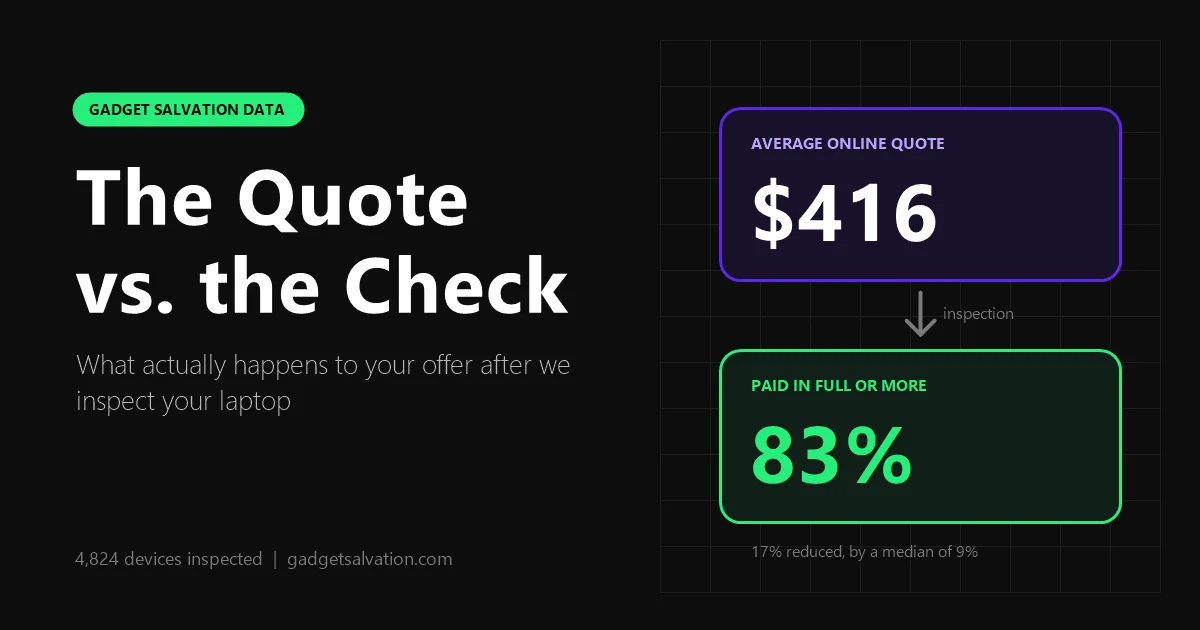
Two things stand out. First, a reduction is the exception, not the rule. More than eight in ten devices were paid the amount the calculator showed, or more. Second, when a reduction does happen, it is usually moderate. Half of all reductions were 9% or less, and the average was $39 on an average quote of $416.
The 169 increased offers deserve a mention too. These are devices that arrived in better shape than described, or with more memory or storage than the seller selected. When a technician finds a better machine than the one that was quoted, the offer goes up. It is not common, but it is part of the same process, and it's why we ask sellers to describe their device rather than guess low to be safe.
| Outcome after inspection | Devices | Share |
|---|---|---|
| Paid exactly the quoted amount | 3,835 | 79% |
| Paid more than quoted | 169 | 4% |
| Paid less than quoted | 820 | 17% |
What a Typical Price Adjustment Looks Like
Percentages are abstract, so here is the same picture in dollars. The average quote across all inspected devices was $416. For devices revised downward, the average reduction was $39, bringing the quote to $377. At the median reduction of 9%, a $416 quote becomes $379.
| Scenario | Amount |
|---|---|
| Average online quote | $416 |
| Quote after the median reduction of 9% | $379 |
| Quote after the average reduction of $39 | $377 |
The difference between the median and the average tells you something about the shape of the reductions. Most are small: a worn keyboard, a missing charger, a battery that has lost capacity. A minority are large, and those pull the average above the median. The large ones are almost always cases where the gadget that arrived was not the one that was quoted: a locked BIOS the seller could not clear, a laptop with a broken screen behind a "Fully Functional" online description, or a lower-spec unit than the one selected. A device quoted as working but won't boot upon arrival has very little resale value, and the revised offer reflects that.
Reasons for Reductions
Every revised offer comes with a detailed inspection report sent to the seller before any payment is processed. Listed in order of frequency, these are the findings our technicians record most often:
- Cosmetic wear beyond the selected tier: Scratches, dents, worn or discolored palmrests, and shiny keys on a device described as "Flawless" or "Good". This is the most common finding by a wide margin.
- Missing charger or accessories: The calculator asked, the seller answered "Yes", and the box arrived without it.
- Screen defects: Pressure marks, bright spots, dead pixels, and cloudy patches that are easy to miss under normal room lighting.
- Battery health: A battery that no longer holds at least 2 hours of continuous charge or reports low capacity (less than 60% of original capacity for laptops and less than 80% for phones).
- Wrong model or lower specs than selected: A previous-generation processor, less RAM, or smaller storage than the option chosen online.
- Ports, fans, and thermal issues: Non-functional USB/charging ports, noisy or non-spinning fans, CPU thermal throttling.
- Keyboard or trackpad defects: Unresponsive keys, a non-clicking trackpad, or missing keycaps.
- Physical damage: Cracked corners, broken hinges, and chipped bezels.
- BIOS password, Windows activation problems, or account locks: A firmware password, a Windows or Apple account still attached, or activation lock.
- Will not power on: Less frequent, but this finding causes the largest price drop from the initial quote.
Pro Tip: Three of the top five issues above can be checked in under two minutes, and the second one is 100% avoidable. If you cannot locate the charger, simply select "No" on the calculator, and the system will apply a small deduction upfront, preventing a surprise revision later.
Low Estimates Have Less Room for Surprises
There is one more pattern worth understanding. A missing charger, a worn keyboard, or a weak battery costs roughly the same to remedy whether the laptop is worth $150 or $800.
This is why an honest description matters most on budget devices. On a high-value laptop, a minor oversight results in a small price revision. On an entry-level one, it can lead to a dramatic reduction. If you are selling an older or low-spec gadget, take an extra minute to verify its condition carefully and ensure every included accessory makes it into the shipping box.
What Happens After a Revised Offer?
When an inspected value differs from your online quote, you receive an email detailing the technician's findings alongside the updated offer. Nothing is paid until you approve it. You have two choices:
Accept the revised offer and collect your payout immediately.
Decline the offer and have your gadget shipped back to you, free of charge.
In practice, 94% of sellers who receive a revised offer accept it. To us, that is the most important statistic in this article. It shows that when a technician explains what was found and breaks down the math transparently, most sellers agree the adjusted price is fair.
For the small minority who decline, it is usually because the model was misidentified in our buyback database, resulting in a significantly lower resale value than the model originally selected, or because the gadget turned out to be too old to qualify for an offer. In cases where an offer can't be made, we do offer free eco-friendly recycling, though you can always choose to have it shipped back to you.
How to Get the Full Amount You Were Quoted
Everything above points to the same practical observation: An accurate online description yields an accurate payout. In fact, 83% of sellers receive the full amount they were quoted (or more).
Here is how to ensure you are one of them:
- Confirm the exact model and configuration. Check the processor, memory, and storage in the system settings rather than relying on memory. Mismatched specs are among our top five inspection findings.
- Inspect the body under bright light. Tilt the lid under direct lighting. Check the corners, palmrest, bottom case, and hinges. If you see any dent or scratch, it is not Flawless. If the keys' finish is worn through, it is not Good.
- Check the screen on a white background in a dim room. Open a blank document, turn the brightness up, and look for cloudy patches, bright spots, or lines—defects that are easy to miss under ambient light.
- Check your battery health. On a Mac, open the battery health panel in System Information. On Windows, run the built-in battery report. A battery well below its design capacity is a recurring cause for a reduction.
- Tick every issue that applies. If the device has a specific fault, select it in the issues checklist. A quote that already accounts for a bad battery won't be further revised upon arrival.
- Be honest about the charger. If you cannot find the original power adapter, answer "No" to the "Will the charger be included?" question. The calculator will apply the deduction upfront, ensuring the inspection goes smoothly.
- Remove every lock. Sign out of your Apple ID or Microsoft account, clear any BIOS or firmware password, turn off Find My, and reset the computer to factory settings. A locked device can lose a lot of the buyback value, but resolving this is 100% within your control.
Why We Publish This
Sellers deserve to know the odds before they ship their gadget to us. A buyback quote is only useful if it is reliable, and reliability depends on two things: an honest description from the seller and a fair, explained inspection from us. The figures above represent our side of that bargain. Eight in ten devices are paid in full, the typical revision is modest, and almost everyone who receives an adjusted offer agrees with it once they know why.
We will continue to update these figures as our buyback database grows and testing procedures expand. And if our revision rates move in either direction, we will publish those numbers, too.
Frequently Asked Questions:
How often does Gadget Salvation change the offer after inspection?
The offer was reduced on 17% of inspected devices, 820 of 4,824. Approximately 4% (or 169 gadgets) received a higher valuation offer than quoted. The remaining 79% were paid exactly the amount the calculator showed.
How much is the offer typically reduced?
The median reduction was 9% of the quote, and the average was $39 on an average quote of $416. Most reductions are the result of one condition tier or one missing accessory. Large reductions are rare and almost always involve a non-working device described as functional, a locked device, or a lower-spec/older model than the one quoted.
Do I have to accept a revised offer?
No. You can decline and have the device returned at no cost. Among sellers who received a revised offer, 94% accepted it.
Can the offer go up after inspection?
Yes. Around 4% of inspected devices received a higher offer than quoted, usually because the device had more memory or storage than the seller selected, or was in better cosmetic condition than described.
Which condition tier should I choose?
The one that matches the device. Flawless means you would have to look closely to tell it from new. Good means light, visible wear with nothing cracked, dented, or missing. Fair means visible damage. If you are torn between two tiers, choose the lower one and describe the specific issues in the checklist; a quote that anticipates a problem is not revised for it.
What is the most common reason for a reduced offer?
Cosmetic wear beyond the selected tier, followed by a missing charger or accessory, and then screen defects such as pressure marks and bright spots. Together, those three account for the majority of revisions, and all three can be checked in a few minutes before you ship.